Learning about SEO marketing early can help you when building your website

Most people dream of more freedom, more income, and more control over their future — but far fewer actually understand how to build a business of their own successfully.
Unfortunately, many people try, but nearly 90% of startups are estimated to fail, often not because people lack ambition, but because they lack the right strategy, planning, and framework. Without clear direction, many waste time, money, and energy on ideas that never truly gain traction.
The good news?
Learning how to start a business of your own is rarely about luck — it’s about making smarter decisions, following proven steps, and avoiding common mistakes early.
In this guide, we’ll answer the most common beginner questions and walk you through 7-steps designed to help you align your business idea, avoid costly mistakes, and build with a clearer path toward real success.
The first step for starting a business is choosing an idea that gives you a real chance of success.
This is where many people make their first major mistake. They either follow trends blindly, build around unrealistic expectations, or choose something based only on passion without considering whether people will actually pay for it. While owning your own business can create more freedom and control, success usually starts with choosing the right foundation.
A strong business idea should solve a real problem, meet existing demand, and realistically fit your skills or ability to learn. You do not need to invent something revolutionary — many successful businesses simply improve on what already exists or solve everyday problems more effectively.
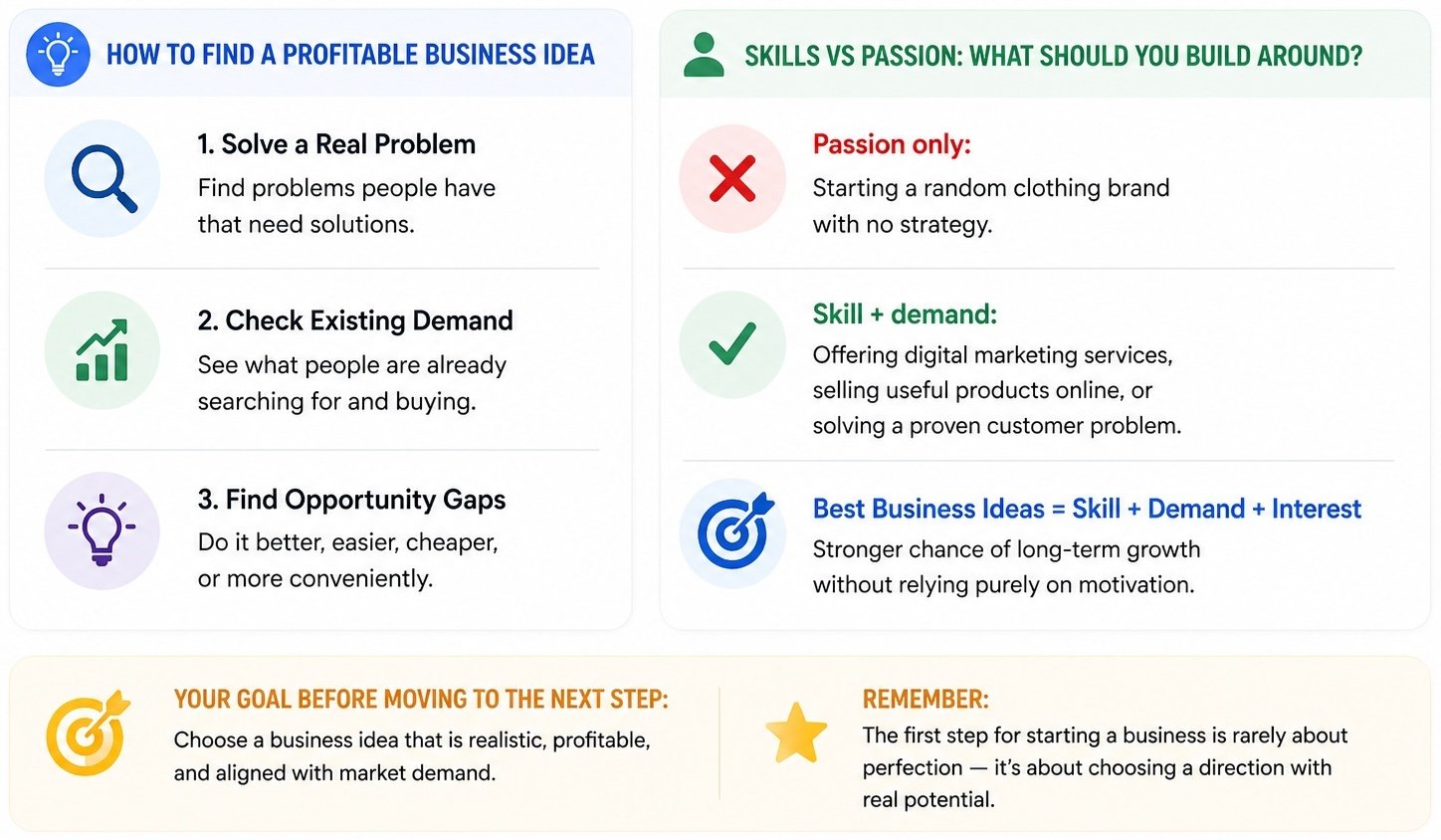
Running a profitable business, you need to find an idea, that solves a real problem people are willing to pay for. Profitable businesses rarely begin with random inspiration — they usually come from identifying demand, solving frustrations, or improving something that already exists.
Most successful ideas come from one of three places:
Look for frustrations, inefficiencies, or everyday challenges people actively want solved.
Use Google searches, keyword tools, forums, and competitor research to discover what people are already spending money on.
Many people succeed not by inventing something new, but by doing it better, simpler, cheaper, or more conveniently than existing competitors.
Many people believe passion should always come first — but passion alone does not guarantee profit.
The smartest approach is often combining:
What you are good at

What people need

What people will pay for
Passion can help with consistency, but practical skills and market demand often determine whether owning your own business becomes sustainable.
For example:
One of the biggest mistakes beginners make is investing time, money, or energy into a business idea before proving that people actually want it.
Many people think starting a business begins with building a product, creating a website, or spending money upfront — but in reality, one of the smartest early moves is business validation. Before going all in, you need evidence that real people are willing to pay for what you offer.
If you’ve ever thought, “help me to start a business, but how do I know if my idea will actually work?” — this is where validation becomes critical.
A great idea means very little if there is no real demand behind it.
The goal of business validation is simple:
Confirm that your idea solves a real problem people are willing to spend money on.
Here are some of the easiest ways beginners can test this:
1. Search demand
Use Google, keyword tools, Reddit, forums, and social platforms to see whether people are actively searching for solutions related to your idea.
2. Competitor proof
If similar businesses already exist, that can actually be a positive sign — it often means demand is already there. Your job becomes finding ways to do it better, differently, or for a more specific audience.
3 Direct feedback
Ask potential customers questions, run polls, or test offers before fully building. Real-world feedback can save you from months of wasted effort.
4. Early sales or pre-interest
Even a few early customers, signups, or inquiries can tell you far more than assumptions.
The key question is:
Interest without payment is not validation.

Market research does not need to be overly complex when you’re starting.
A beginner-friendly approach:
Step 1: Search the problem
What are people already asking online?
Step 2: Analyze competitors
Who is already solving this problem?
Step 3: Look for gaps
Can you do it faster, simpler, cheaper, or better?
Step 4: Test before scaling
Start small before investing heavily.
For example:
Weak validation:
“I think people might like this.”
Strong validation:
“People are already searching for this, competitors are making sales, and I’ve identified a better angle.”
Validate your idea before investing too much time or money. Start small, test real demand, and only commit more when people show clear interest.
Many beginners think an idea either succeeds or fails, but real validation is often about adjustment.
Sometimes the problem is real… but the audience is wrong.
Sometimes demand exists… but pricing is off.
Sometimes people want the result… but not your version.
Early testing helps you refine before wasting serious time or money.
It can reveal:
A better target customer

A stronger offer

Better pricing

A simpler starting point
Many successful businesses are not built from perfect first ideas — they are built from tested ideas improved early.

Yes — you can start a business with no money, and for many beginners, the smartest path is starting small, using what you already have, and building from there.
If you’re wondering how to start your first business with no money, the answer is often not waiting for investors, savings, or the perfect setup — it’s usually about using your existing skills, time, creativity, and accessible tools to start building momentum first.
Many successful entrepreneurs start a business with no money by solving problems, using free or low-cost methods, and reinvesting early profits instead of spending heavily upfront.
Skills
Use what you already know to offer a service, solve a problem, or create value.
Time
Many first businesses grow through consistent effort before major financial investment.
Creativity
Simple outreach, trust-building, and smart marketing can often outperform expensive beginnings.
Tools and platforms
Use Fiverr, Upwork, social media, Facebook groups, local apps, referrals, flyers, testimonials, or a simple website to get visibility and customers.
Imagine you offer social media help, design, cleaning, dog walking, or local chores.
Step 1: Use free tools and platforms
Find early customers through Fiverr, Upwork, Facebook groups, social media, referrals, or local networking.
Step 2: Build trust
Offer strong service, collect testimonials, referrals, before-and-after examples, or word-of-mouth.
Step 3: Reinvest profits
Use early earnings for flyers, better tools, a basic website, or small promotions.
Step 4: Grow strategically
Build a following, improve visibility, and expand once demand increases.
If you have a small budget:
Even $50–$100 can help test flyers, a simple website, product samples, or local advertising.
Start small → Use available tools → Build trust → Reinvest → Scale
| Low-Cost Business Model | Examples |
|---|---|
| Freelancing | Writing, design, consulting, or digital services |
| Service-based businesses | Cleaning, tutoring, coaching, or local services |
| Affiliate content or content creation | Blogs, niche websites, or social platforms |
| Digital products | Templates, ebooks, or online resources |
| Start small ecommerce | Simple few products, test demand, then scale gradually |
Some business models require little to no upfront investment because they rely more on skill than capital.
WHY THIS MATTERS: These models often allow beginners to start with lower risk while learning real business fundamentals.

Once you have a validated idea, the next step is turning that idea into a real business direction.
Many beginners assume startup planning means writing a long, complicated document — but your first business plan can be simple. The goal is not perfection. It’s clarity.
If you want to create company foundations that actually work, you need a basic roadmap for how your business will operate, make money, and grow.
A simple business plan helps answer:
What are you selling?
Who are you selling it to?
How will you make money?
What will it cost to start?
Without this, many ideas never become real businesses.
Your first business plan should cover the essentials:
Your product or service
What are you offering, and why would people buy it?
Your target audience
Exactly what people need this?
Your business model
How will you generate revenue?
Your marketing plan
How will the right people find you?
Your startup costs
What do you actually need to begin?
Think of this as your startup blueprint — simple, practical, and designed to reduce guesswork.
One of the biggest beginner mistakes is ignoring numbers.
Budget:
What will it cost to start?
Pricing:
How much will you charge?
Revenue Goal:
What is your first realistic target?
Examples:
First customer

First $500

First profitable month
Clear, measurable goals create better momentum than unrealistic expectations.

Source: Exploding Topics
One of the hardest truths in business is this:
Nearly 90% of startups are estimated to fail. According to sources from Exploding Topics
That statistic can sound discouraging — but for beginners, it can also be incredibly useful.
Why?
Because most startup failure is not random. Many businesses fail because of avoidable startup mistakes like poor planning, no real demand, weak execution, overspending, or solving problems people do not actually care about.
Understanding why does 90% startup fail can help you avoid becoming part of that statistic.
Failure is often less about ambition — and more about direction.
Many first-time entrepreneurs do not fail because they lacked a good idea — they fail because they make avoidable mistakes that slow or stop progress.
Overcomplicating everything
Spending too much time trying to make the perfect website, logo, product, or plan instead of focusing on action and real progress
Lack of consistency
Starting strong, then losing momentum when success takes longer than expected
Poor customer experience
Ignoring trust, communication, or customer satisfaction
Weak brand positioning
Failing to clearly explain why customers should choose you
Trying to do everything alone
Avoiding support, tools, or outside expertise
Unrealistic expectations
Expecting fast success without understanding that business often takes time
Many beginners delay growth not because they lack potential — but because they overthink, overbuild, or focus on the wrong priorities.
Avoiding startup failure often means simplifying, staying focused, and building smarter systems.
Keep it simple early
Focus on solving one clear problem before adding unnecessary complexity
Prioritize action over perfection
Execution usually teaches more than endless planning
Build trust early
Strong customer experience can outperform bigger competitors
Learn sales and communication
Even strong ideas fail without customers
Stay adaptable
Markets change, and flexibility often matters more than rigid plans
Build systems over chaos
Simple repeatable processes often outperform overcomplicated strategies
One of the biggest lessons I’ve personally experienced across different ventures and projects is this:
Simplicity and action often create more traction than overcomplication.
When I focused on solving a real problem and simply got started, progress often came faster than expected. Momentum built more naturally, consistency became easier, and results usually came from being in the process — not from endlessly planning or trying to perfect every detail before taking action.
In contrast, overcomplicating things often created the opposite:
More hesitation

More inconsistency

More wasted time
Spending too much time trying to perfect every strategy, detail, or setup can delay the one thing that often matters most early on:

Is $100 enough to start a business? Yes — $100 can be enough to start a business, depending on your business model and startup costs. Many beginners use $100 for a domain, simple website, hosting, basic marketing, or small product testing, especially when starting lean.
While some businesses require far higher startup costs, many beginner-friendly businesses can start with a modest budget if you focus on simplicity and essential tools first.
Typical startup costs for a small beginner setup may include:
• Domain name – Your website address
• Website + hosting – Your online foundation
• Basic product or starter inventory – What you sell or test
• Simple marketing – Flyers, ads, or promotions
• Email or business tools – Communication and operations
For many first-time entrepreneurs, $100 may not build a large business immediately — but it can often be enough to create a starting point, test ideas, and build momentum.
The key:
Lower startup costs = More flexibility
In many cases:
$100 is not about scaling big — it’s about starting smart.
Starting does not always require a lot of money, but you should still plan for basic costs, unexpected expenses, and enough time to test your idea properly.
The biggest cost difference often comes down to this:
Are you selling a product, or are you starting with something smaller and easier to validate?
Lower-cost businesses often need basic tools, marketing, or setup, while product-heavy businesses may require:
Product development

Inventory

Packaging

Shipping

Equipment
This is why many beginners benefit from starting smaller. Many successful businesses begin with one product, one service, or one focused solution, then expand once demand is proven.
Starting small can reduce financial pressure, help validate faster, and create traction with less risk. Expanding later within the same niche is often smarter because it strengthens trust, branding, and customer understanding.
Success is rarely about starting big —
It’s about starting focused and expanding strategically.
Many new entrepreneurs do not fail because they lacked money —
They fail because they spend too much too early.

Overinvesting in product before demand

Large inventory purchases

Branding before revenue

Scaling too early

Ignoring hidden costs
One of the biggest mistakes is treating a startup like a finished company instead of an early-stage test.
A smarter approach is simple:
Validate demand first

Keep costs lower

Start focused

Expand strategically
Money matters — but how you use it matters more.
Before moving forward, ask yourself:
Is product my biggest cost?

Can I test smaller first?

Am I scaling too early?
Many businesses fail because costs outpace proof. Starting smarter means controlling risk before chasing scale.
In this article, you’ve learned what starting a business actually requires, what common mistakes to avoid, and how to keep startup costs low so getting started feels more realistic.
For many beginners, the cheapest path is often starting simple, staying strategic, and building gradually.
• Choose an idea that solves a real problem
• Avoid common beginner mistakes like overspending or overcomplicating
• Start with your existing skills, time, or accessible tools
• Keep costs low and reinvest as you grow
• Build trust, get customers, and create momentum
• Expand strategically once the foundation works
If you now feel ready to get started, it’s important to choose a platform that fits your goals and business needs. Read our guide on Which Website Platform Is Best for Your Business? to compare Shopify, Wix, WordPress, and Squarespace and find the best fit for your business.
Additional questions many first-time entrepreneurs ask beyond the main guide.
It depends on where you live and how you operate, but many beginners benefit from understanding local business registration, taxes, and legal basics early to avoid future problems.
Starting alone can offer more control, while a partner may bring additional skills, support, or resources. The right choice often depends on trust, shared goals, and clear responsibilities.
It depends on the business model, industry, and execution. Some businesses can earn quickly, while others may take months. Consistency, demand, and marketing often make the biggest difference.
Not always, but social media can be one of the cheapest ways to build visibility, trust, and early customer attention. Many beginners combine it with websites, referrals, or local outreach.
Many successful entrepreneurs do not succeed on their first attempt. Failure often provides useful lessons, helping you adjust, improve, or pivot toward a stronger business opportunity.

Practical business, mindset, and lifestyle content to help you grow.
Explore practical articles designed to help you think better, build smarter, and move forward.
Explore Articles →