
Research shows that optimal work hours per day fall between 4–6 focused hours. Within this range, the mind stays sharp, creativity remains high, and burnout becomes far less likely. Working smarter in short, deep sessions consistently creates more progress than endless grinding.
Important context: If you work with your brain, not your body, how you use your hours matters more than how many hours you work.
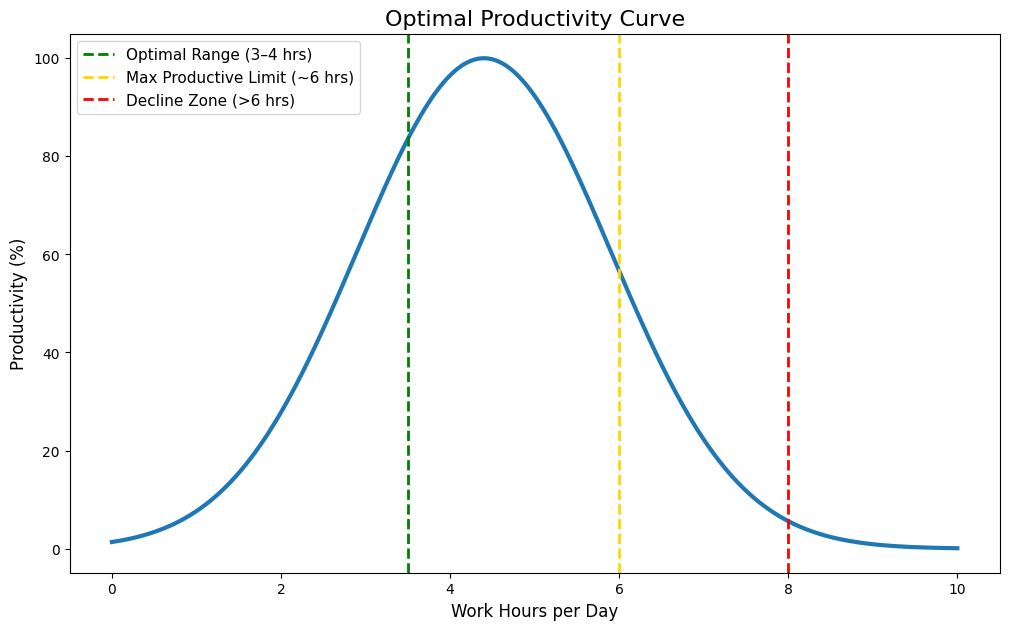
Most productive range: 3–4 hours of deep, focused work per day (within the maximum productive hours for knowledge workers)
Maximum effective limit: ~6 hours per day — beyond this, error rates rise and efficiency drops
Weekly upper threshold: ~50 hours (aligned with the 50 hour rule for burnout prevention)
Mentally demanding work: Focus and decision quality decline after 2–3 intense hours
Health impact beyond limits: Increased fatigue, sleep disruption, cognitive overload, and long-term risks linked to overworking
The science is clear—fewer focused hours within optimal work hours produce better overall output.
Working longer is often counterproductive; over time, it increases cognitive load, disrupts work recovery, and makes it harder to enter a flow state.
This helps answer a common question: is it unhealthy to work a lot? Long-term overworking is linked to declining human productivity, managing side hustle fatigue becoming harder, and even brain structure changes from overworking
What this means: Pushing longer hours doesn’t build discipline — it slowly wears down focus, energy, and consistency.
Source: Globalleadership
For maximum focus, follow the proven rhythm:
52 minutes of work → 17 minutes of rest.
Short breaks help your brain recover and keep your energy stable throughout the day.
| Time | Focus | Notes |
| 09:00 – 09:52 | Deep Work Session 1 | Tackle your most important task. |
| 09:52 – 10:09 | Break (17 min) | Move, stretch, hydrate. |
| 10:09 – 11:01 | Deep Work Session 2 | Continue or shift to task #2. |
| 11:01 – 11:18 | Break (17 min) | Give your brain a real reset. |
| 11:18 – 12:10 | Deep Work Session 3 | Wrap up the morning’s focus block. |
| 12:10 – End | Lunch / Recharge | Finish strong after 3 focused hours. |
Adjust the hours worked to see your productivity level.
Peak productivity happens around 3–4 hours of focused work.
If you already work full-time, you’re not starting at full energy.
Reduce intensity — aim for 2–2.5 hours of deep side-hustle work in the evening.
This keeps you consistent without burning out.
| Time | Focus | Notes |
| 17:30 – 18:00 | Break / Dinner / Reset | Transition after your day job. |
| 18:00 – 18:52 | Deep Work Session 1 | Creative or strategic work. |
| 18:52 – 19:09 | Break (17 min) | Step away completely. |
| 19:09 – 20:01 | Deep Work Session 2 | Continue progress or finish key tasks. |
| 20:01 – 20:30 | Wrap-up | Emails, scheduling, light planning. |
Source: Timecamp
According to data from the Organisation for Economic Co-operation and Development, countries with shorter working hours—such as Germany and Denmark—often achieve higher productivity per hour than countries where employees work longer hours, like Greece.
This shows that optimal work hours, efficiency, and well-being matter more than total time worked, especially for knowledge workers.
Research shows productivity declines once weekly work exceeds 40–50 hours, supporting the 50 hour rule for burnout prevention.
John Pencavel (Stanford University) found productivity drops sharply after 50 hours, with no added benefit beyond 55 hours.
A Slack study found employees who work overtime have ~20% lower productivity than those who log off on time.
These findings suggest that working excessively can be unhealthy, contribute to side hustle fatigue, and increase cognitive strain over time.
What this means: If your weeks keep getting longer but results don’t improve, your system is broken — not your work ethic.

Source: Timecamp
Protecting the quality of your work matters more than working longer hours—especially for knowledge workers. Research shows that maximum productive hours for knowledge workers are limited, and exceeding them reduces output. From personal experience, long days with few breaks lowered my hit rate, reduced lead quality, and hurt customer satisfaction.
Understanding optimal work hours is essential, particularly when managing side hustle fatigue. Employees working extended shifts make 9% more mistakes, which is why many follow the 50 hour rule for burnout prevention—performance drops sharply beyond this point.
So, is it unhealthy to work a lot? The data says yes. A study published in The Lancet shows that working more than 55 hours per week increases the risk of depression by 66% and anxiety by 74%. Chronic overwork also contributes to brain structure changes from overworking, affecting focus and emotional regulation.
According to the World Health Organization, working 55 hours per week raises the risk of stroke by 35% and heart disease by 17% compared to a standard 35–40 hour workweek.
Working smarter—not longer—creates the real edge.
Source: Howmuch
| Country | Productivity per hour (USD) | Region | Typical workweek pattern |
|---|---|---|---|
| 🇱🇺 Luxembourg | $68.47 | Western Europe | Shorter hours, very high efficiency |
| 🇳🇴 Norway | $52.50 | Scandinavia | Short workweeks, strong work–life balance |
| 🇨🇭 Switzerland | $50.08 | Western Europe | High skill density, efficient hours |
| 🇩🇰 Denmark | $38.16 | Scandinavia | 37-hour workweek, focus-driven culture |
| 🇮🇸 Iceland | $36.52 | Scandinavia | Reduced hours, strong output per hour |
Countries like Norway, Denmark, and Iceland are known for:
Shorter standard workweeks built around optimal work hours
Strong protections against excessive overtime
High trust, autonomy, and deep-focus work culture
Clear separation between work and recovery
Source: PubMed Central
The goal isn’t to work more—it’s to manage energy within optimal work hours. The good news is you don’t need extreme schedules to make progress.
Just 2 focused hours, Monday–Thursday, fits within the maximum productive hours for knowledge workers and gives you 8 productive hours per week—without sacrificing sleep.
What this means: Consistency beats intensity when energy is limited.
Research behind the 50 hour rule for burnout prevention shows that overwork leads to fatigue and sleep disruption. So, is it unhealthy to work a lot? Long-term evidence points to yes, including stress and brain structure changes from overworking.
That’s why 8 hours of sleep is non-negotiable. By protecting recovery and managing side hustle fatigue, you preserve focus and consistency.
You can still add extra work on weekends—just be intentional. Take breaks, protect recovery, and stay mentally clear. A clear head is priority number one.
Health category | Description | Risk strength |
Physiological Health (PH) | Cardiovascular disease, hypertension, diabetes | Moderate ↑ |
Mental Health (MH) | Depression, anxiety, psychological distress | Moderate ↑ |
Health Behaviours (HB) | Smoking, alcohol use, inactivity | Mixed ↑ |
Related Health (RH) | Sleep disturbance, fatigue, injuries | Highest risk ↑ |
Non-specified Health (NH) | General health outcomes | Moderate ↑ |
t’s clearly important to get your 8 hours of sleep, but mental health issues are also closely linked to stress and cognitive overload. To achieve maximum efficiency, comfort, and a generally calm state, you should implement an energy-saving framework in your everyday life.

Productivity studies on shorter workweeks—across both countries and companies—show a clear pattern: less strain leads to higher output.
One standout example is Microsoft Japan, which saw a 40% increase in productivity after reducing work hours. While this is an ideal outcome, most people don’t have that option. That’s why this framework focuses on reducing mental strain rather than cutting hours.
To put this into perspective, professional chess players can burn up to 1,500 calories in long matches due to extreme cognitive strain—without any physical movement
1. Match Tasks to Energy (Not Time)
High energy → Thinking, problem-solving, planning
Medium energy → Meetings, collaboration
Low energy → Emails, admin, routine work
2. Decide Once, Not Repeatedly
Fixed start-of-day routine
Fixed lunch and break habits
Batch emails and messages
Use default responses instead of constant decisions
3. Reduce Task Switching
One task at a time
Group similar tasks
Don’t mix deep work with communication
4. Externalize Everything
Write down tasks, ideas, and worries
Keep one central task list
Park thoughts instead of remembering them
5. Protect Recovery
Short breaks every 60–90 minutes
Eat lunch away from screens
End the workday with a clear stop
Avoid energy drains:
Constant interruptions & notifications
Unclear priorities or vague tasks
Meetings without outcomes
Rechecking email/chat all day
Multitasking
Trying to look busy instead of effective
How to treat your 9–17 (energy-wise):
Do your job well—don’t overspend energy
Focus on what’s required, not perfection
Avoid unnecessary overtime
Let go of what you can’t control
Use all breaks
Detach mentally during breaks
Goal: Leave work with energy left, not depleted.
Source: Webmd
The ideal amount of sleep depends on age and lifestyle — but for most adults, 7–9 hours per night is the sweet spot for focus and productivity.
If you often feel tired or unfocused during the day, it’s a sign you’re not getting enough rest.
Sleep isn’t a luxury — it’s part of your performance routine.
1. Work at a desk or table — posture supports focus.
2. Choose a bright, clean space with natural light.
3. Remove distractions — phone out of sight, notifications off.
4. Make a 3-task list for each work block.
Keep a positive mood — good music helps focus, negativity kills it.
So, how many hours should you work per day?
For most people, the optimal range is 4–6 focused hours. Within this window, you get the highest output per hour, better decision quality, and far lower risk of burnout. Pushing beyond it doesn’t create more progress — it usually creates more fatigue, mistakes, and recovery debt.
If you’re building a side hustle or working a demanding job, 2–3 hours of deep, focused work per day is enough to make consistent progress without sacrificing sleep, health, or long-term motivation.
Intent-driven answers to common questions readers still have after learning the science of productivity.
Yes — when fewer hours are structured as focused, distraction-free work. Shorter workdays reduce cognitive fatigue, preserve decision quality, and make it easier to show up consistently. Over time, this leads to more output than long, unfocused days.
Productivity often plateaus or declines after the first few focused hours. The extra time is usually spent on low-value tasks, rework, or shallow activity. This creates the illusion of effort without meaningful progress — and increases burnout risk.
Common signs include slower thinking, more mistakes, irritability, trouble sleeping, and needing more time to recover. If your output per hour is falling while your hours increase, you’ve passed your optimal work limit.
Batching work into clear focus blocks is far more effective. It reduces task-switching, lowers mental friction, and makes it easier to enter deep work. Spreading work thinly across the day keeps your brain in a constant reset state.
Yes. Most productivity gains come from removing friction: fewer decisions, fewer tools, fewer interruptions, and clearer priorities. When mental load drops, output rises naturally — even with the same number of hours.
Occasionally, yes — but only if recovery is planned. Without recovery, extra hours borrow energy from future days. Sustainable progress comes from consistency, not from pushing until exhaustion.
Learn the real mental frameworks, habits, and identity shifts that top entrepreneurs use to rise above the competition and stay ahead.
Read the article →
Practical business, mindset, and lifestyle content to help you grow.
Explore practical articles designed to help you think better, build smarter, and move forward.
Explore Articles →